The 3 A.M. Shift: Inside the Overnight Build Before the Biggest Reptile Show in the Southwest
Photo: Ynhockey, CC BY-SA 4.0, via Wikimedia Commons
At 10:47 p.m., the convention hall smells like cardboard and hand sanitizer. The overhead lights are cut to half power, and somewhere in the dark, a crestie chirps from a tote that hasn't found its table yet.
This is load-in night — the twelve hours nobody sees and everybody benefits from.
The Cattle Call at the Loading Dock
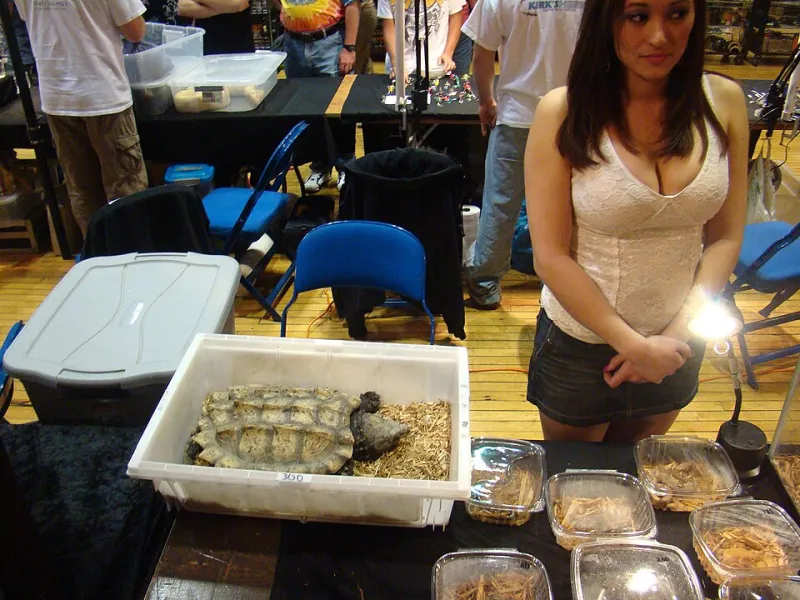
Load-in officially kicks off at 6 p.m., but the line of trucks and trailers starts stacking up two hours early. Vendors from as far as Texas and California time their drives so they roll in together, and the dock crew — a rotating squad of volunteers, teenage kids of longtime exhibitors, and a few guys paid in vendor credits — runs a tight choreography of hand trucks and rolling carts.
Racks first. Always racks first. A breeder's whole weekend lives in those stackable tub systems, and nobody wants to carry a 60-pound rack three aisles deeper than necessary.
"We've got it down to about 45 minutes per booth if the vendor shows up organized," says one dock coordinator, who asked to remain anonymous because he's technically not supposed to be forklift certified. "If they show up organized. That's the whole game right there."
Paperwork Before Animals, Every Single Time
Before a single snake touches a display tub, state and show paperwork gets checked. For an Arizona event, that means import permits for out-of-state vendors, species lists verified against what's actually in the trailer, and health documentation for the animals that require it.
Show staff do a walk-through with first-time vendors around 9 p.m. — part inspection, part orientation, part therapy session. New breeders are usually nervous. Veterans are usually already eating dinner in a folding chair behind their booth.
The rule of thumb everyone repeats: if it's not on your species sheet, it doesn't get sold. The paperwork isn't bureaucracy for its own sake; it's what keeps the whole event legal and repeatable year after year.
Heat Packs, Totes, and the Logistics of Keeping 10,000 Animals Comfortable
Here's a number that bends people's brains: on a typical show weekend, there are somewhere north of 10,000 live animals on the floor. Ball pythons stacked in rack systems. Leopard geckos in rows of display tubs. Amphibians in misted cubes. Feeder insects by the flat.
Every one of them needs a temperature band, and the hall's HVAC can only do so much overnight. That's where heat packs come in — the little chemical warmers you snap and shake, tucked into shipping totes for animals waiting to be displayed. Vendors burn through them by the case. The show itself stocks extras for anyone who underestimated the desert night, which drops colder than most out-of-towners expect, even in summer.
The humidity crowd has it harder. Keepers of tropical species haul their own misting bottles and humidity gauges because the building air is dry enough to make a crested gecko sulk by morning.
The 3 A.M. Problem Nobody Plans For
Every load-in has a moment. This year, it was a vendor's display freezer — the one meant to keep feeder rodents at proper temperature — dying around 3 a.m., two hours after the compressor started making a sound nobody liked.
Cue the scramble. Another vendor had a spare unit in their trailer. A volunteer ran extension cords across two aisles. The stock got redistributed into backup coolers with thermometer strips taped to the lids. By 4:15, the crisis was a story, and by 7 a.m. it was a joke told at the coffee station.
That's the real texture of load-in: not drama, exactly, but a rolling series of small problems solved by people who've been doing this long enough to know that something always goes sideways. A bulb burns out. A tub cracks. A vendor's flight lands late and their booth neighbor sets up their tablecloth as a courtesy.
The Unsung Crews
If you come to the market and have a great day, here's who to quietly thank:
- The dock crew, who moved roughly four tons of racks and tubs before midnight.
- The vet and inspection team, who walk the floor before doors open and again during the show.
- The facilities folks, who spend the overnight adjusting HVAC zones aisle by aisle because the reptile rows run warm and the amphibian corner runs cool.
- The overnight security, who keep an eye on a building full of valuable, living inventory.
When Doors Open
By 8 a.m., the lights are full, the aisles are swept, and the hall hums with the sound of a thousand animals settling in. Vendors grab one last coffee. Show staff do a final lap. And the doors open on what looks, to the average guest, like it just appeared overnight.
It didn't. It was built by hand, one tub at a time, while the rest of the city slept.
So this year, when you walk in and marvel at the wall of ball pythons or the table of impossibly tiny geckos, remember: somebody was up at 3 a.m. babysitting a freezer so your Saturday could go smooth. Maybe tell them so.